Finishing a Basement in Atlanta: Cost, Permits, and ROI
The dollar amounts here are the numbers we see show up in actual closings, not the national averages that show up in lender brochures.
Cost Per Square Foot Ranges
- Full-daylight basements common ITP
- $30-75/sqft finished typical
[Review: confirm the bullets above are accurate for Atlanta, then add one sentence on what we tell clients here.]
Permit Requirements by County
- Egress windows required for bedrooms
[Review: confirm the bullets above are accurate for Atlanta, then add one sentence on what we tell clients here.]
What Adds Value at Resale
[Review: confirm the bullets above are accurate for Atlanta, then add one sentence on what we tell clients here.]
Egress + Code Gotchas
[Review: confirm the bullets above are accurate for Atlanta, then add one sentence on what we tell clients here.]
Waterproofing in Atlanta
[Review: confirm the bullets above are accurate for Atlanta, then add one sentence on what we tell clients here.]
How Atlanta’s Geology and Lot Type Drive Your Real Finishing Budget
The $30 to $75 per square foot range is real, but where you land inside that range depends heavily on what’s under your house, not just what finishes you choose. Atlanta sits on the Piedmont Plateau, which means a significant portion of homes in Decatur, Kirkwood, and Morningside rest on lots with clay-heavy soil that shifts seasonally and pushes moisture toward foundation walls in ways that flat-terrain markets simply don’t experience. A basement that looks dry in January can show active seepage by late March after a wet February. Before a single framing nail goes in, that question has to be resolved, and waterproofing work in Atlanta typically runs $4,000 to $14,000 depending on linear footage and the system installed, which can swing your total project cost by 20 percent or more.
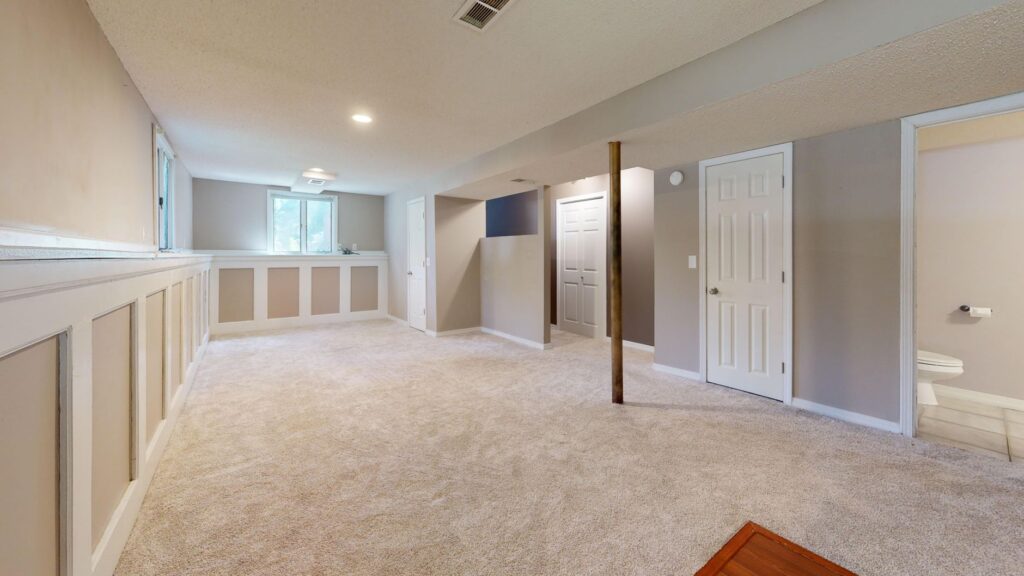
Lot type adds another variable most national cost calculators ignore entirely. Full-daylight walk-out basements, common in Buckhead, Sandy Springs, and parts of East Cobb, carry lower finishing costs because natural light and an existing exterior door eliminate the need for egress window cuts and reduce the mechanical work to meet livable-space code. Partial basements and below-grade basements, more common in older Virginia-Highland and Grant Park bungalows, need egress windows for any room classified as a bedroom, and each cut runs $1,500 to $3,500 in Atlanta depending on the contractor and the foundation material. If you’re evaluating a home with a below-grade basement and penciling in a future finishing project, build those egress costs into the model from day one.
What Finished Basement Square Footage Actually Does to Your Resale Price in Atlanta
The ROI question on basement finishing gets muddied because Atlanta appraisers and the MLS treat finished basement square footage differently depending on how it was built and permitted. Permitted, above-grade finished space counts toward your above-grade square footage, which directly affects your price-per-square-foot comparison against comps. Below-grade finished space, even when permitted and well-executed, is typically listed separately in the MLS and appraised at a lower rate per square foot than above-grade living area. In practice, we see below-grade finished space appraising at roughly 50 to 70 percent of the per-square-foot value assigned to above-grade rooms in the same home, which means a $60,000 finishing project on a fully below-grade basement rarely adds $60,000 to appraised value at resale.
That math changes when you look at specific submarkets and use cases. In Brookhaven and Dunwoody, where lot sizes constrain additions and buyers are actively seeking extra square footage, a finished basement with a full bath, separate exterior entrance, and kitchenette commands real attention and compresses days on market. The same finished space in a neighborhood where most comps already have finished basements adds less marginal value because it’s table stakes, not a differentiator. Before committing to a full finishing budget, we recommend pulling the active and sold comps in your specific zip code to see how finished basements are being priced and appraised locally. The right project in the right submarket can still generate strong returns. The wrong scope in the wrong neighborhood is an expensive amenity you’re building for yourself.
Frequently Asked Questions
The earlier you build these numbers into your plan, the fewer surprises at closing. We can pull a personalized estimate for your price range and county before you write an offer, which is far more useful than the generic calculators online. Atlanta costs vary measurably by county, and the standard national estimates are typically off by 10 to 30 percent for our market.
For a typical Atlanta transaction in the $400K to $800K range, this category usually runs $4,000 to $18,000 depending on which county, your specific lender, and the deal structure. The spread is wide because Fulton’s fee math differs from DeKalb, and Cobb differs from both. We can pull a tight estimate once we know your target county and price range.
Some yes, some no. Lender fees and title fees have some flexibility — shopping two or three providers can save real money. Government fees (transfer tax, recording fees) are fixed. Seller concessions toward closing costs are a real lever in this market, especially on listings sitting over 21 days. Buyers leave this lever on the table more often than they should.
Property-related fees vary by county. Fulton has the highest millage rate in the metro but offers a generous homestead exemption for primary residents. DeKalb is mid-range with strong school-zone variation in tax burden. Cobb runs lower on most categories but the math changes again if you’re inside vs. outside Marietta’s city boundaries. We always pull county-specific numbers before the offer goes in.
Build the full cost picture before you commit to a number, then structure the offer with the right combination of price, concessions, and closing-date flexibility. Most buyers focus only on price; the smartest offers in this market use all three levers. The end-of-year tax position, your loan type, and your timing flexibility all play in.
Get pre-approved with a lender who’ll share their actual fee structure (not all do). Pull a real estimate for your target county. Then talk to us about how to structure the offer to minimize what you bring to the table. Book a 15-minute call and we’ll walk through it.
Want a Specific Answer for Your Situation?
These are the typical Atlanta numbers. Your specific lender, property, and county will move them. If you want a personalized estimate, grab 15 minutes on Valerie’s calendar. No sales pitch, just a direct answer. Or send a note through the contact page.
This post reflects current Atlanta market conditions as of June 2026. Tax rules, lending terms, and fees can change. For legal, tax, or compliance questions, consult a qualified Georgia professional.
Featured photo by Peter Vang on Pexels.